Curating the biblical and Reformed theological traditions in order "to make the Word of God fully known"
Monday, October 6, 2025
Psalm 9 [Merely Human]
Saturday, January 4, 2025
"Savior of the World" [Big Sky Savior]
Just in time for Epiphany, A.D. 2025. Pastors, please share with your membership and outreach committee. Link to it in your newsletters.
Tuesday, December 24, 2024
"Writing Case" [Born to Free] — Post 2
So, what is this about a writing case? In Ezekiel 9, the prophet sees a man, a clear Christophany, dressed in linen and carrying a writing case who is told to pass through the city of Jerusalem and mark everyone who sighs (with dismay) over the sins committed in the city; this proto-baptismal mark, like the blood of the Passover lamb at the Exodus, plays a protective function, because the Lord was about to destroy the city, as he did the Egyptian firstborn in the tenth plague (a judgment upon Egypt for Pharoah's destruction of the male children of the Hebrew slaves). In short, those with this protective mark will be spared. Remember how the liturgy of the Sacrament of Baptism says: "child of the covenant, you have been sealed by the Holy Spirit and marked (!) as Christ's own forever." The water is applied, drips off, and dries, but the invisible, spiritual mark is permanent, yes, eternal, because the child of the covenant is now engrafted and incorporated into the very body of the Christ who has conquered death, himself the Resurrection and the Life. Baptism into Christ, in which he marks us as his own, is the death to sin that exempts us from a second, permanent death.
Meanwhile, Revelation (which frequently refers to the imagery we find in the book of Ezekiel) speaks of the Lamb's book of life (Rev 3:5; 13:8; 17:8; 20:12, 15; 21:27), a register of those whose names are written in heaven (Luke 10:20) and thus marked for salvation. [There is, of course, that other mark mentioned in the book of Revelation, i.e., the mark of the beast, universally recognized as the mark of those destined for a very different, unhappy end, but this is the happy opposite of that.]
NOTE (likely to be repeated): Although this track is available on most major streaming services, I actually use very few social media platforms; so, when it says, "Please share with those you love," I would be grateful if you would funnel this musical "Jesus prayer" to your loved ones by way of (copy and paste links to) any social platforms that you happen to use. Thank you for doing so. Thank you, as well, for going the extra mile to support indie authors and musicians by, not just liking, but sharing, purchasing downloads, spreading the word, etc. God bless you. God bless us, everyone.
Wednesday, November 29, 2023
This Friday, December 1, marks 500 years from the first sermon delivered in this pivotal series on 1John
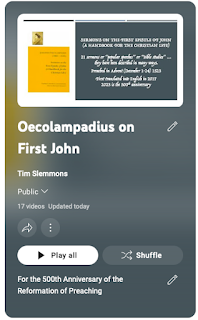
Friday, December 1, 2023, marks the 500th anniversary of the beginning of this sermon series of twenty-one sermons by Oecolampadius preached every evening during Advent in December 1523 (leaving out Sundays, but leading upon toe Christmas Eve). Though it was a weekday (evening) series, the lectio continua style of straightforward, comprehensive Bible teaching (1) represented an historic reclamation of patristic expository preaching, and (2) set the standard that would be implemented by ordinance in all the pulpits of Basel some five years after these sermons were published. Though Oecolampadius was gone by the time Calvin arrived in Basel, every church in town was ringing with the form of preaching offered here. There can be no doubt that Calvin will have had a copy of the series, which sold through several editions in multiple languages very quickly. Surely for this reason, among others, Oecolampadius can be called, and indeed he has been called, Calvin's "spiritual father."
Not only are the sermons lively, accessible, and illuminating, Oecolampadius' selected book of the Bible, The First Epistle of John, proves a perfect focal point for this Advent series, for a fresh approach to the then-current debates over the doctrine of justification, and as he himself says, the book is a veritable "Handbook for the Christian Life."
Here is the playlist of videos consisting of one 30-minute introduction to "The Reformation of Preaching" and 16 very short intros to the individual (or occasionally groups of) sermons:
https://www.youtube.com/playlist?list=PLZZ9pVHWq-xaT3XJ5qBOIwmzg55ZPLx4X
Kindle available at Amazon:
Paperback available at Amazon:
Hardcover available at Barnes & Noble:
Wednesday, June 21, 2023
Heinrich Bullinger's Sermons on the Apocalypse The First Vision (Revelation 1—3)
The first 22 of Bullinger's 101 sermons on Revelation. What more orthodox and trustworthy (human) interpreter of the Apocalypse could the church ask for than the author of the Second Helvetic Confession?
Wednesday, November 30, 2022
499 years old, now going on 500
This historical and pivotal sermon series began on December 1, 1523. It evidently ran right up through Christmas Eve.
2023 would be a great time to have a Bible study on 1John, with Oecolampadius' sermon series to guide you.
Here is a playlist of 17 videos consisting of a 30-min Introduction and sixteen short summaries by Oecolampadius' leading biographer, Ernst Staehelin (a contemporary colleague of Karl Barth); the summaries are newly translated and read as introductions to Bible Study sessions.
Meanwhile, as further evidence of just how groundbreaking this series was, check out this link; notice whose name appears first and notice the categories:
Tradition = Reformed and Genre = Sermon / Sort = Date (Oldest)
The title in question is the third on the list. The first is Oecolampadius' translation of a patristic sermon, the second is a collection of three sermons from 1521, which merit translation, but do not quite represent the full breakthrough to the Reformation, as they were produced while he was still in the monastery.
For the hardcover version of the Sermons on the First Epistle of John, and also for additional translations of related material, ... these Works of Oecolampadius are appearing at Barnes & Noble.
Thursday, October 8, 2020
Return to God: Historical and Modern Confessional Sources for the Renewal and Regathering of the Church
My latest book gathers a number of sources together that (1) are previously unpublished or are translated here into English for the first time, (2) have struck me as important both in their original time and context and (potentially) for our time and place, (3) share a common confessional conviction (in both the "penitential" and the "professional" sense), and (4) may be of particular value as the Church shakes off it Covid shackles and regathers to pray, sing (!), worship, celebrate the sacraments, and breath in the Holy Spirit together.
Two sermons from the American Awakenings are here: one by Gilbert Tennent (First GA) on how we should listen to sermons, and another by Samuel Miller (Second GA) on the glory of the Gospel.
Several first-ever English translations are also included (which I mention here in reverse chronological order):
- the long prayer from the London journal of the brilliant critic of the Enlightenment, Johann Georg Hamann;
- a prayer of confession "for more difficult times" from Oswald Myconius (the successor to Oecolampadius in Basel)
- three pieces from the Oecolampadius corpus:
- A Litany to God the Father (a clear attempt to reform the rosary in a more orthodox direction, this is a wonderful tool for commiting the life, work, and ministry of Jesus to memory)
- Questions and Answers for the Examination of Children (a child's catechism)
- Discourse at the Synod of Basel (1531), delivered not long before the Reformer's death and culminating in his own Profession of Faith.
- the opening and closing prayers of confession from the 1520 edition of Jodocus Windsheim's Confession of a Repenting Christian, to which Oecolampadius provided the preface. Earlier editions of this piece have roots going back to at least early 1517. It made a big impression on Oecolamapadius, who later wrote his own attempt to reform the penitential rite.
Friday, March 20, 2020
The Good Confession
Monday, January 6, 2020
Salix Babylonicus: A Youth / Adult Sunday School Discussion Guide
Monday, April 9, 2018
The Children's Sermon
Wednesday, September 27, 2017
Do we really need another biography of Calvin?
Meanwhile, if we study (from the other end) the rise of Oecolampadius and the reformation of preaching in Basel that he represents; i.e., that he modeled and practiced, and that Basel eventually prescribed, we can likewise make the case that, despite the gradual pace of the progress of Basel's reforms and the variety of approaches to preaching Oecolampadius used in the eight years between 1523 and his death in 1531, the model for the expository preaching that Calvin heard in Basel, almost regardless of where he worshipped from Sunday to Sunday, was that of Oecolampadius and (at its root) this very sermon series, the first complete biblical exposition to survive from the Swiss Reformation.
The hypothesis (or hunch) in a nutshell: By a providential and inspired trail of influence, the spark of simple exposition leaped from the 4th c. preacher John Chrysostom to his translator Oecolampadius, igniting the "house lamp" of the Reformation; through him it spread to the ministers of Basel, caught hold of Calvin by way of their preaching, and through Calvin it reached the world. This hypothesis is admittedly simplistic and in some respects all too "linear," for it makes no mention of Zwingli, Capito, Bucer, Farel, et al., but it (at very least) recognizes and states the obvious point that few Calvin devotees care to admit: that Calvin did not invent or adopt his approach ex nihilo or even from the mere advice of certain other reformers; it also fills most plausibly the influence gap, the yawning silence of the first Basel period, acknowledging the company of preachers (Myconius, Karlstadt, Wissenberg, et al.) through whose sermons the Spirit most likely formed Calvin as a preacher, those who shared and modeled for him the calling to teach the Scriptures from the pulpit clearly, methodically, comprehensively. I also recognize that many members of this company were also newly arrived when Calvin came, many perhaps did not hear Oecolampadius himself in the pulpit, but they came committed to the program of biblical exposition that he, more than any other individual, (re)established.
Now live on Amazon, finally, after nearly 500 years ...
Saturday, October 29, 2016
Our Father Knows (now on Kindle)
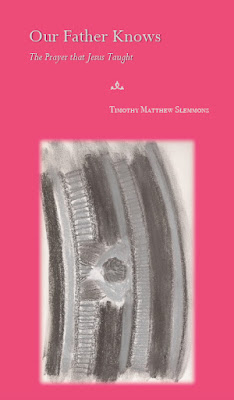
Our Father Knows: The Prayer That Jesus Taught
ORIGINAL POST (03-16-2016): In the aftermath of Super Tumult, er, Tuesday, and before St. Patrick's Day sees everyone, shall we say, forgetting what St. Patrick stood for (well, hopefully not everyone), it seems like "3/16" may be a good day to publish a book, and not just any book, but a book on The Lord's Prayer. I suspect we need it — by which I mean "the Prayer" more than the book, but the book, too.
So, for those who share my conviction that we need to earnestly beseech our heavenly Father right about now — and indeed every day — let me introduce Our Father Knows: The Prayer that Jesus Taught. This short series of studies is the artifact of an adult Sunday School course I offered in early 2003. After my comprehensive exams and the submission of my dissertation proposal I had about a month before I could expect feedback on the proposal; given the chance to offer some adult ed, I thought I would try and tackle one of the chief catechetical "heads." Only once I got into it did I discover what a mammoth amount of literature there is on "the Prayer" — yes, the definite article is merited — so I pretty much stuck with first things first, namely, reading the petitions within the reverberations of the canon itself. The Foreword lists what are (to my mind) the chief secondary sources that a thorough study should take into account, if it were to venture beyond biblical study itself and into the history of Christian thought, interpretation, and preaching on the Lord's Prayer. It is quite possible I may have missed something important, especially since the recommended list of titles "For Further Reading" is admittedly light on commentaries. Including whole book commentaries would have added a level of research I did not and do not have the time to undertake, so let me refer any interested parties to the Biblical Studies department for that. All of which is to say, this was and is a quick study, prepared intensively but on the fly, without significant revision to what was first offered, despite the baker's dozen years that have since lapsed.
Perhaps you might consider using this for a Sunday school class or other adult ed event, or find in it inspiration for a sermon series on the Lord's Prayer. Sooner or later, and perhaps especially at this juncture, we need to remember the importance of catechesis, including catechetical preaching, do we not? [Where Year D is concerned, I have suggested Matthew 6:7-15 as the gospel lection for the Fifth Sunday of Ordinary Time, but I do think the petitions are well worth at least one sermon each.]
Meanwhile, for an added bonus, see the final pages where, in "An Eschatological Postscript," you will find a prayer composed of (relatively neglected) petitions, other things for and about which Jesus also said we should pray. Can you imagine what the good Lord might do if we were to actually start praying for such things?
May your faith be strengthened by this study and may those with whom you serve the Lord be well nourished by it as well. Blessings and peace in Christ to one and all.
Friday, January 1, 2016
Prayers of Confession (General)
O God, you are faithful and just to forgive us our sins.
Mercifully grant that we may be delivered from the bondage of sin,
and that we may one day rejoice in perfect liberty
in our very Fatherland, which is in heaven. Amen.
and enter into your promised joy. Amen.
Thursday, December 31, 2015
Friday, March 6, 2015
The Freedom of Christ
More specifically and somewhat pedagogically, I offer it as an example of what I call "reiterative exposition," which is, as I understand it, akin to what Walter Brueggemann calls "re-utterance." For the record, I do realize that while Brueggemann favors, promotes, and envisions preaching as "re-utterance" of the Word, he is less positive about "reiteration." The difference, if there is one, seems to me less clear and stark than it evidently does to him. So with that expression of intent, i.e., that I think we are aiming at the same thing, here it is: a reiteration or a reutterance (as you like) of the gospel of freedom, The Freedom of Christ.
UPDATE: For some reason, according to Google Trends, there seems to be particular interest in Galatians in Zimbabwe these days, so perhaps this title will grab some African readers. Note as well the rising interest in the epistle itself, in contrast to the diminishing interest in the lectionary.
Monday, September 2, 2013
A Phenomenal Llama
Available at CreateSpace:
A Phenomenal Llama: A Tall Christmas Tale for Children of All Ages
On Amazon:
and Kindle:
And make sure to visit, "like," and "share" Gregory's FB page. (It's time to put this reindeer thing to rest, isn't it?)